History
Chance in Art: How Artists Use Accidents on Purpose
Written by Froissage Editorial Team · Updated
Chance in art is the deliberate use of accidents. Instead of planning every mark, the artist lets something unplanned decide part of the picture: where torn paper lands, how a sheet creases, where ink spreads when two surfaces are pressed together. Froissage, the technique this site is about, is one of the clearest examples: you crumple a sheet, open it and let its creases suggest the image. This guide traces how chance moved from a studio trick to a serious method, and how you can use it in your own work.
Before the method: stains, blots and walls
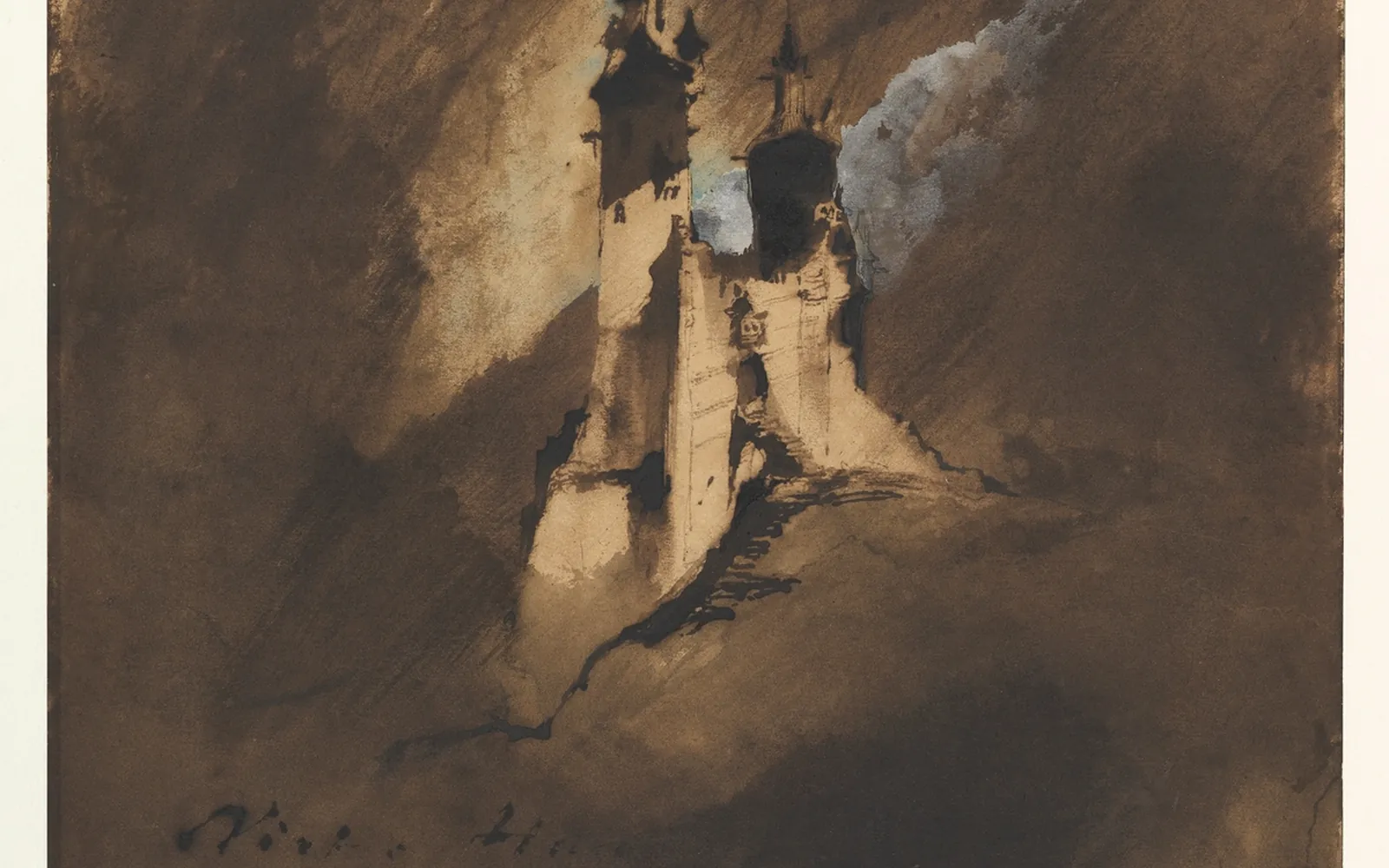
Artists noticed long ago that random textures help the imagination. Leonardo da Vinci advised painters to look at stained walls and mixed stones until battles, landscapes and faces appeared. In the eighteenth century, Alexander Cozens taught students to start landscape compositions from quick ink blots. Victor Hugo, the writer, made many ink drawings in which spills, stains and pressed paper became castles and storms (see our guide to Victor Hugo’s ink drawings).
In all these cases chance is a starting point. The accident provides a shape; the artist recognises something in it and develops it. The psychological side of this, seeing faces and figures in random forms, is explained in our page on pareidolia in art.
Dada: chance as a way out of habit
In the 1910s chance became a principle rather than a trick. Two works are usually cited.
Hans (Jean) Arp made a series of collages in Zurich in 1916-17 in which squares of paper were, by his account, arranged “according to the laws of chance”. MoMA, which owns one of them, says these collages privilege chance over artistic intention. It also adds an honest caveat: the result looks fairly orderly, which suggests Arp did not fully give up control.
Marcel Duchamp made 3 Standard Stoppages in 1913-14. He dropped three threads, each one metre long, from a height of one metre and fixed the curves they made as they landed. The curves became templates, a kind of ironic ruler set by chance.
For both artists, chance was a way to escape personal taste and the habits of the trained hand.
Surrealism: chance as a tool for the imagination
The Surrealists of the 1920s and 1930s used chance to reach the unconscious. They developed a toolkit of techniques that produce unpredictable textures:
- Frottage, introduced by Max Ernst in 1925: rubbing pencil over paper laid on wood grain, leaves or fabric. Tate’s art-terms page describes it as the technique of taking a rubbing from an uneven surface. See our frottage art technique guide.
- Decalcomania, popularised by Óscar Domínguez in 1936: paint pressed between two surfaces and pulled apart. See decalcomania and our profile of Óscar Domínguez.
- Fumage, developed by Wolfgang Paalen in the late 1930s: marks made with candle smoke. See fumage and Wolfgang Paalen.
- Grattage: scraping layers of paint to reveal textures beneath, covered in our grattage guide.
- Exquisite corpse: a drawing game in which each player adds a part without seeing the rest, explained in our exquisite corpse page.
Froissage: chance in a crumpled sheet
Froissage applies the same logic to a single sheet of paper. Crumpling is quick and uncontrollable: no two sheets crease the same way. After opening the sheet, the artist inks or paints it so the creases show, then reads figures and landscapes into the network of lines. The Czech poet and artist Ladislav Novák made froissage a central part of his work in the 1960s (see Ladislav Novák), and in France painters linked to Supports/Surfaces, such as André-Pierre Arnal, crumpled and folded whole canvases. For the basics, read what is froissage.
After 1945: chance as a system
In the post-war years chance often became a rule-based system rather than a door to dreams. The composer John Cage used the I Ching, the Chinese book of changes, to make decisions while composing Music of Changes (1951), and his ideas spread to visual artists. Ellsworth Kelly made collages in which the placement of coloured squares was decided by chance, an approach that echoes Arp. Later artists used dice, computer randomness or simple instructions that anyone could follow.
The difference matters. For the Surrealists, chance revealed hidden images. For Cage and many later artists, chance removed the artist’s ego from decisions. Both approaches are still useful in a studio or classroom.
Why chance is useful in practice
Chance methods help in three practical ways:
- They beat the blank page. A crease, blot or rubbing gives you something to respond to.
- They break habits. If you always draw the same faces or use the same colours, a chance step forces variety.
- They train looking. Finding a horse in a crumpled sheet is an exercise in careful observation.
They are also inclusive. Children, beginners and experienced artists can all crumple, drop or blot, and the results are unique each time. Our froissage lesson plan shows how to build a full session around this.
Three chance exercises to try
Dropped paper collage. Tear a sheet of coloured paper into ten pieces, hold them at shoulder height over a larger sheet and let them fall. Glue each piece where it lands. Repeat with a second colour.
Crease and find. Crumple a sheet of cartridge paper, open it, brush thin ink over it and let it dry. Turn the sheet in all directions and outline the first figure you see. This is the core of how to do froissage.
Dice palette. Number six colours. Roll a die for each area of a simple drawing and paint it in whatever colour comes up. Notice which combinations you would never have chosen.
Keeping control where it counts
Chance is never total. You choose the paper, the ink, the scale, which result to keep and how far to develop it. Many artists describe the process as a conversation: the material proposes, the artist responds. That balance between accident and decision is what makes chance in art more than a gimmick.
Two more chapters of the story: the cameraless pictures of Christian Schad and Man Ray, explained in how to make a photogram, and the spattered soil paintings described in Jean Dubuffet’s Texturologies.
Frequently asked questions
What does chance mean in art?
It means that the artist hands part of the decision-making to an unplanned process, such as dropping, folding, crumpling, blotting or throwing dice, and then works with whatever that process produces.
Who first used chance in art?
Artists have long used stains and accidents as prompts; Leonardo da Vinci recommended looking at stained walls for scenes. As a deliberate method, chance is most closely linked with Dada artists such as Hans Arp and Marcel Duchamp in the 1910s.
Is froissage a chance technique?
Yes. The creases of a crumpled sheet are unpredictable, and the artist then reads figures and landscapes into them. It belongs to the same family as frottage and decalcomania.
Does chance art mean the artist does nothing?
No. Almost every chance method involves choices: which material to use, which result to keep and how to develop it. Even MoMA notes that Arp's chance collage looks fairly orderly, suggesting he did not give up control entirely.
Sources
Editorial team
The Froissage.com editorial team researches the history of froissage from museum, encyclopedia and publisher sources and writes practical guides to the technique.