Classroom
Exquisite Corpse Drawing Game: Rules, History, Ideas
Written by Froissage Editorial Team · Updated
The exquisite corpse drawing game is one of the simplest ways to make a picture nobody could have planned. Several people draw parts of a single figure on a folded sheet of paper, each without seeing what the others have drawn. When the sheet is opened, a creature appears that belongs to everyone and no one: a bird’s head on a robot’s body standing in rubber boots. The Surrealists in 1920s Paris turned this game into an artistic method, and it sits naturally alongside froissage, which also asks chance to start a picture.
Where the game comes from
The exquisite corpse grew out of an older parlour game called consequences. In consequences, players write in turn on a sheet of paper, fold it to hide what they wrote and pass it on; the result is a short, absurd story. Tate describes the Surrealist drawing version as consequences adapted so that parts of the body are drawn instead of written.
Tate dates the invention to 1925 in Paris. Wikipedia summarises André Breton’s own account: the game began at an old house at 54 rue du Château in Montparnasse, and the first players included Breton, Marcel Duhamel, Jacques Prévert, Yves Tanguy and Benjamin Péret. Tate’s list of founders differs a little, and the poet Pierre Reverdy claimed the game was played earlier, so the exact origin is best described as a circle of friends rather than a single inventor.
The odd name comes from the written version. One of the first sentences the group produced was “Le cadavre exquis boira le vin nouveau”, “the exquisite corpse will drink the new wine”. The phrase stuck. Breton reported that the game started as fun but became enriching. For the Surrealists it was a way to produce images and phrases that no single mind would have invented, which is exactly what they were looking for.
The game spread with the movement. Wikipedia records that Frida Kahlo and Lucienne Bloch made exquisite corpse drawings together in 1932, and Tate’s collection includes a large Exquisite Corpse series by Jake and Dinos Chapman from 2000. We do not reproduce these works here because they are in copyright; the museum pages show examples.
Why it belongs with froissage
At first sight a party game and an ink technique have little in common. Yet both use the same Surrealist idea: give up some control at the start, then respond to what appears. In froissage, the creases of crumpled paper supply the unplanned lines (see what is froissage). In the exquisite corpse, the other players supply them. Our overview of Surrealist art techniques places the game alongside frottage, decalcomania and froissage.
Basic rules
You need one sheet of paper per game and a pencil or pen for each player.
- Fold the sheet into equal horizontal strips, one per player. Four strips is the classic layout: head, torso, legs, feet.
- The first player draws a head in the top strip and lets the lines of the neck run a few millimetres past the fold.
- They fold the drawing back so only those small guide marks show, and pass the sheet on.
- Each player continues from the guide marks, draws their section, hides it and leaves new marks.
- When the last section is finished, unfold the sheet and look at the whole figure together.
Two rules make the game work: never peek, and always leave guide marks so the sections join. Without the marks, the parts float apart and the effect is lost.
Variations for different ages
- Three-part version for young children: head, body, legs. Use a thick pencil or felt tip and large paper. Show one round on the board first so the folding makes sense.
- Creature theme: decide on a theme before folding, such as animals, monsters or machines, so that children have a starting point.
- Froissage corpse: crumple and ink the sheet first, as in our step-by-step froissage guide, then fold it and play. Each player must use at least one crease in their section.
- Collage corpse: each player glues a section cut from magazines instead of drawing, close to how the Surrealists used collage.
- Word version: each player adds a word in a fixed order, for example adjective, noun, verb, adjective, noun, then the sentence is read aloud.
- Halloween corpse: in October, play with monster parts and display the results with the creatures from our Halloween froissage monsters project.
Running it in a classroom
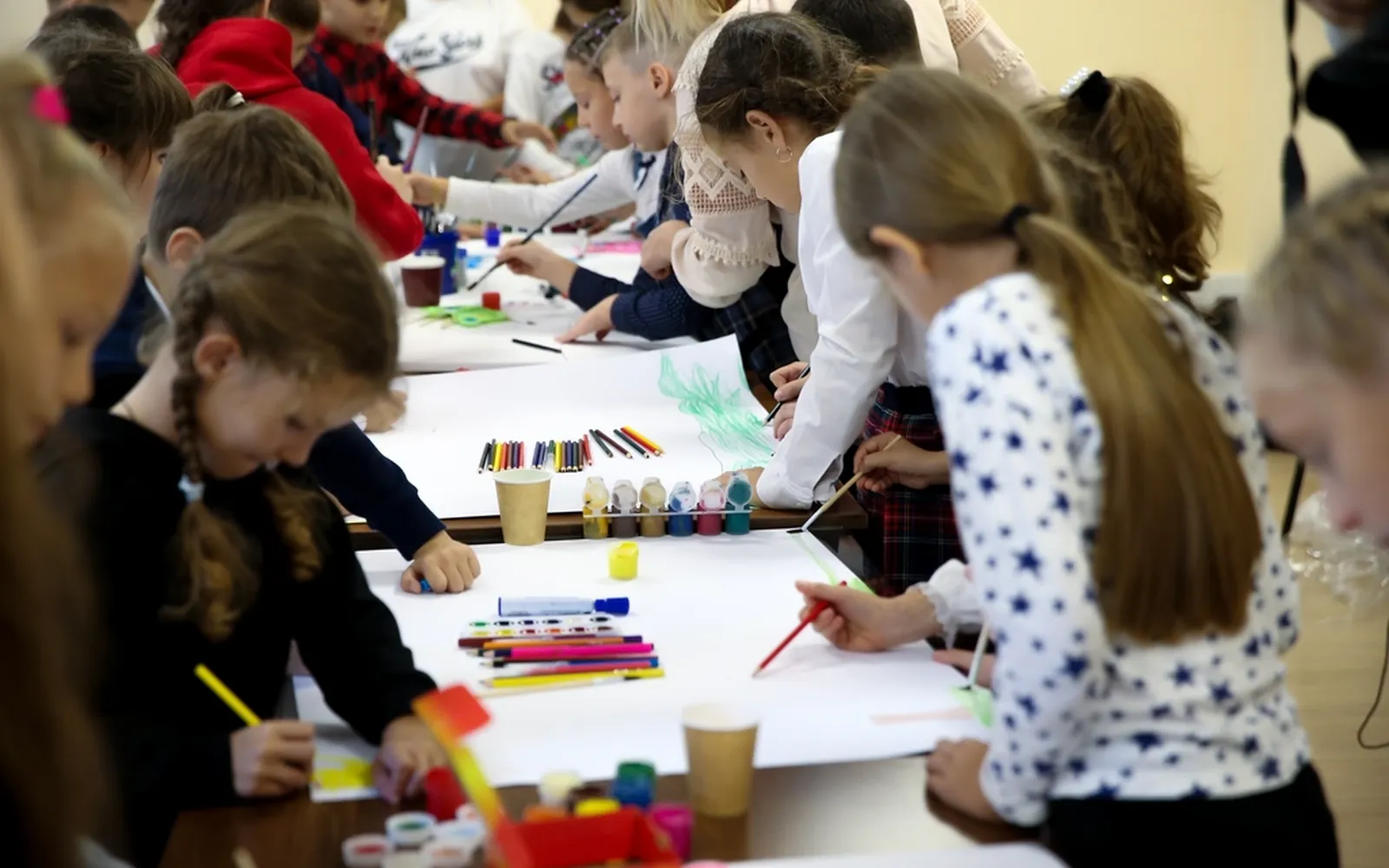
Seat pupils in groups of four with four sheets per group. Everyone starts a head at the same time; after a set time, each sheet moves one place to the left. After four rounds every pupil has contributed to four figures and every sheet is complete. Open them all at once for the reveal.
Follow the game with a short discussion: which figure surprised you most? Did anyone try to guess what the previous section looked like? How is this like finding pictures in a crumpled sheet? A natural second lesson is a froissage session, using the sequence in our froissage lesson plan. For younger groups, our froissage for kids activity is shorter and needs fewer materials.
Tips for better drawings
- Encourage players to fill their section edge to edge so that the figure feels continuous.
- Mix drawing tools: one player in pencil, the next in pen. The changes of line make the joins more surprising.
- Use thin paper for the reveal but thick paper if you want to colour the result afterwards.
- Keep the finished sheets; a wall of exquisite corpses makes a strong display. Our guide to displaying froissage art has simple hanging ideas that suit paper drawings.
If your group enjoys the surprise of the unplanned line, follow up with a round of automatic drawing, the Surrealist exercise in which the hand moves without a plan.
Frequently asked questions
What is the exquisite corpse drawing game?
It is a collaborative drawing game. A sheet of paper is folded into sections; each player draws one part of a figure, folds it out of sight, leaves small marks showing where the lines continue and passes it on. When the sheet is opened, the figure is a surprise to everyone.
Why is it called exquisite corpse?
The name comes from the Surrealists' first round of the written version of the game, which produced the sentence 'Le cadavre exquis boira le vin nouveau' ('The exquisite corpse will drink the new wine'). The odd phrase stuck as the name of the game.
Who invented the exquisite corpse?
It adapts an older parlour game called consequences. Tate dates the Surrealist version to 1925 in Paris. In André Breton's account it was played at a house at 54 rue du Château with Marcel Duhamel, Jacques Prévert, Yves Tanguy and Benjamin Péret; Tate's list of founders differs slightly.
How many people do you need?
Three or four players is the classic number, one per section. Two players can alternate sections, and a whole class can play in groups of four with several sheets passing at once.
What age is the exquisite corpse game suitable for?
Children from about five can play a simple three-part version (head, body, legs). Older pupils and adults can use more sections, add rules or play the word version.
Sources
Editorial team
The Froissage.com editorial team researches the history of froissage from museum, encyclopedia and publisher sources and writes practical guides to the technique.