History
Victor Hugo Ink Drawings: Blots, Stencils and Stains
Written by Froissage Editorial Team · Updated
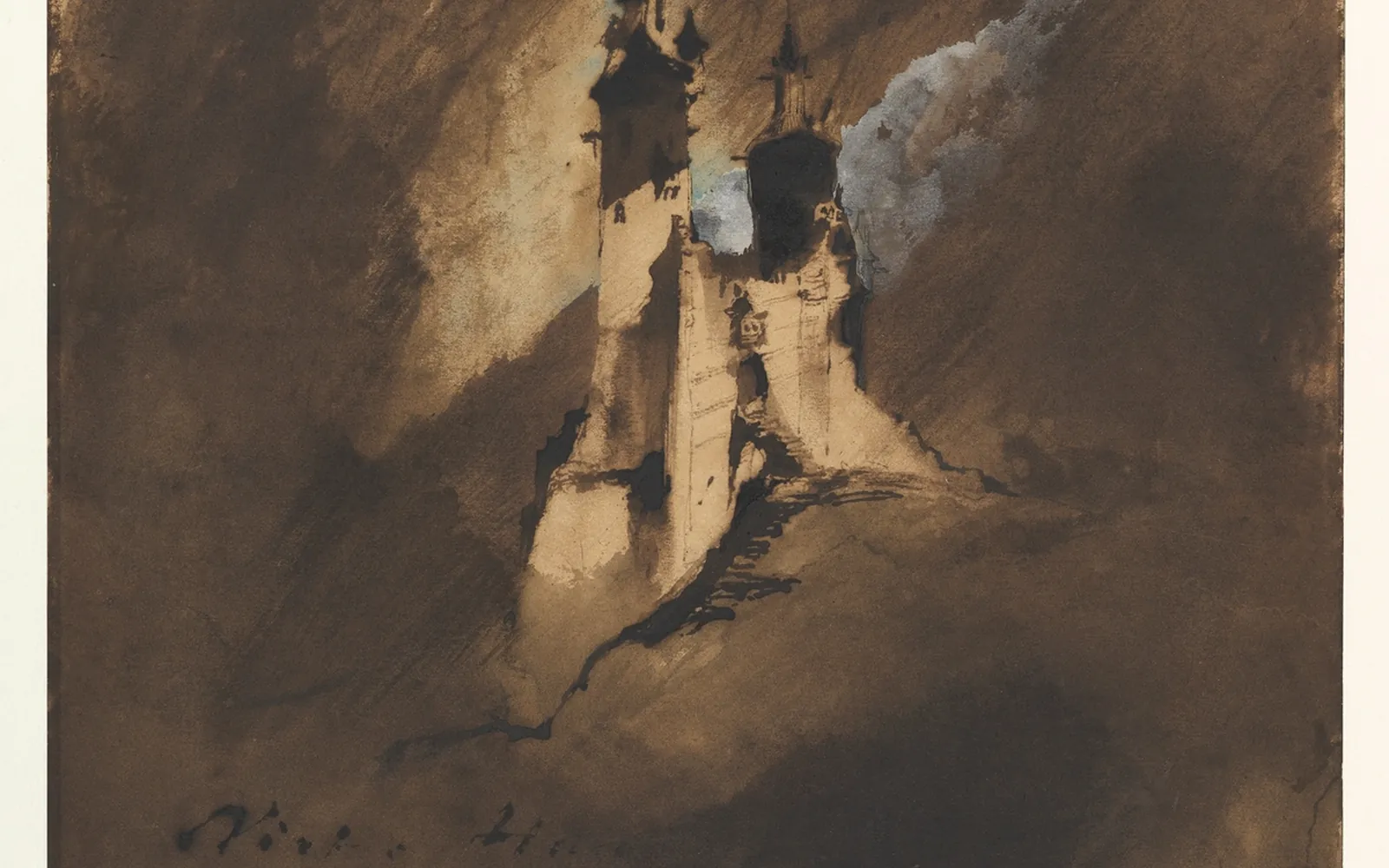
Victor Hugo ink drawings come as a surprise to people who know him only as the author of Les Misérables and Notre-Dame de Paris. The novelist and poet was also a prolific and daring draughtsman. Working with ink, wash, stains and improvised tools, he made dark castles, stormy seas and abstract blots that look strikingly modern. Because he let accidents start many of his images, Hugo belongs to the long history of chance techniques that leads to the Surrealists and to froissage. This guide explains his methods, the main periods of his drawing and where to see the originals.
A writer who drew
Hugo (1802-1885) produced a very large body of graphic work. Wikipedia states that he made more than 4,000 drawings in his lifetime; the Hammer Museum in Los Angeles, which organised the 2018 exhibition Stones to Stains, notes that more than 3,000 sheets survive, and that few were shown publicly during his lifetime. He worked only on paper and on a small scale, usually in dark brown or black pen and ink wash, sometimes with touches of white, and rarely in colour.
Drawing was a private activity for him: something he did for himself, his family and friends, alongside his writing. That privacy gave him freedom to experiment.
The main periods
The Maison de Victor Hugo, the museum in his former apartment on the Place des Vosges in Paris, traces the development of his drawing:
- Early 1830s. Witty caricatures made for his own amusement and for family and friends.
- From 1834. Travel journals filled mostly with pencil sketches of places and architectural details, later copied in ink for his children.
- 1839 and 1840. Journeys along the Rhine, whose castles, or burgs, became a lasting obsession.
- Around 1847. The museum dates his full mastery and his own technique, combining lithographic crayon, charcoal and ink wash, to this period.
- Exile, 1852-1870. After Louis-Napoléon’s coup, Hugo lived in exile on the Channel Islands of Jersey and then Guernsey. The Hammer Museum notes that many of his works date from these years. The Maison mentions fantastic drawings linked to the séances held on Jersey, seascapes, and designs for the furniture and decoration of his house on Guernsey, Hauteville House.
The drawing reproduced at the top of this page, Souvenir of a Castle in Vosges (1857), comes from the exile years. The Metropolitan Museum of Art, which owns it, records that the outline of the castle was obtained by using a paper stencil. Hugo’s works are in the public domain, so the Met makes the image freely available.
Blots, stencils and stains: Hugo’s methods
The Maison de Victor Hugo and the Hammer Museum describe a range of methods, many of them unconventional for the time:
- Pools and blots. He wet or turned the paper so that ink ran and pooled into shapes he had not planned, then read those shapes as skies, rocks or waves.
- Stencils and cut-outs. He cut shapes from paper or card and washed ink around them, as in the castle above. The same stencil could produce several versions with different atmospheres.
- Imprints. He pressed lace, leaves and his own fingertips into the wet medium to add texture.
- Folding. JSTOR Daily notes that he tilted or folded soaked or spattered sheets, a gesture close to the folded blot of later decalcomania.
- Mixed media. Ink combined with white gouache, charcoal, graphite, chalk or crayon.
- Scraping and cracking. The Maison notes that he scraped the surface and used a soluble screen to produce a cracking effect.
Some of his sheets are almost pure stain, with no subject at all, which is why they are often described as anticipating abstraction.
Hugo and the Surrealists
The Maison de Victor Hugo notes that the Surrealists and many 20th-century artists admired his inkblots for their early signs of automatism and abstraction. The painter André Masson asked whether these blots were technical tests or the first steps of a creative process awaiting interpretation. That is exactly the question chance techniques raise. Hugo’s stains belong in the same family as Alexander Cozens’ blot landscapes and Justinus Kerner’s inkblot pictures, discussed on our page about pareidolia in art, and as the Surrealists’ decalcomania and frottage.
Froissage takes the same principle into a new material. Instead of ink spreading in water, a crumpled sheet provides the random pattern, and the artist interprets it. Our history of froissage follows that thread from Surrealism to Ladislav Novák.
Where to see his drawings
- Maison de Victor Hugo, Paris. The largest collection, with more than 700 items, according to the museum.
- Hauteville House, Guernsey. His home in exile, part of the same museum network.
- Bibliothèque nationale de France, the Musée d’Orsay and international collections including the Metropolitan Museum of Art in New York, all of which lent to the Hammer exhibition.
Check each museum’s website for current displays; works on paper are shown in rotation to protect them from light.
Hugo’s methods next to later techniques
Many of Hugo’s experiments have names today because later artists turned them into methods. His tilted and folded wet sheets resemble the folded blots of decalcomania; his imprints of lace and leaves recall both frottage and the cameraless prints described in how to make a photogram, where photographic pioneers also laid lace and leaves on sensitised paper; his habit of reading skies and castles in pools of ink is the same act of looking that automatic drawing and froissage depend on. None of this means Hugo invented those techniques: he worked privately and mostly for himself. But it explains why the Surrealists found his drawings so congenial.
The link with crumpled paper is also practical. A sheet that has been crumpled and flattened takes ink washes in uneven pools, very like the wet, tilted paper Hugo used, so a froissage sheet is a good surface for trying his effects.
Trying Hugo’s methods yourself
You do not need to imitate Hugo’s subjects to learn from him. Work with one dark ink, let it pool, use a stencil and a scrap of lace, and finish with a few pen lines, as in the steps above. The wash techniques in our guide to froissage with ink and watercolour work just as well here, and combining a Hugo-style stain with a crumpled sheet, following our step-by-step froissage guide, is a good way to feel how two kinds of accident can work together.
Frequently asked questions
How many drawings did Victor Hugo make?
Estimates vary. Wikipedia states that Hugo produced more than 4,000 drawings in his lifetime, and the Hammer Museum notes that more than 3,000 sheets survive. Few were shown publicly while he was alive.
What techniques did Victor Hugo use in his drawings?
Mainly pen and brush with ink washes, often with white gouache, charcoal, graphite or crayon. He let ink pool into unplanned shapes, used stencils cut from paper or card, pressed lace, leaves and his own fingertips into the wet medium, and scraped the surface for highlights.
Where can I see Victor Hugo's drawings?
The Maison de Victor Hugo on the Place des Vosges in Paris holds more than 700 items, the largest collection. The Bibliothèque nationale de France, the Musée d'Orsay and museums such as the Metropolitan Museum of Art in New York also hold drawings. Hauteville House, his home in exile on Guernsey, is part of the same museum network.
Did Victor Hugo influence the Surrealists?
The Maison de Victor Hugo notes that the Surrealists and many 20th-century artists admired his inkblots for their early signs of automatism and abstraction. The painter André Masson wrote about them.
Are Victor Hugo's drawings related to froissage?
Not directly; Hugo did not crumple paper as a method. But like froissage, his blots and stains begin with a chance mark that the artist then interprets, which places him among the forerunners of chance-based techniques.
Can children try Victor Hugo's drawing techniques?
Yes, with simple materials: diluted ink or watercolour, card stencils, lace or leaves for imprints, and thick paper. Avoid anything involving smoke or flames; the blot, stencil and imprint methods are safe and give very Hugo-like results.
Sources
Editorial team
The Froissage.com editorial team researches the history of froissage from museum, encyclopedia and publisher sources and writes practical guides to the technique.