Artists
Óscar Domínguez and Decalcomania: Surrealism's Inkblot
Written by Froissage Editorial Team · Updated
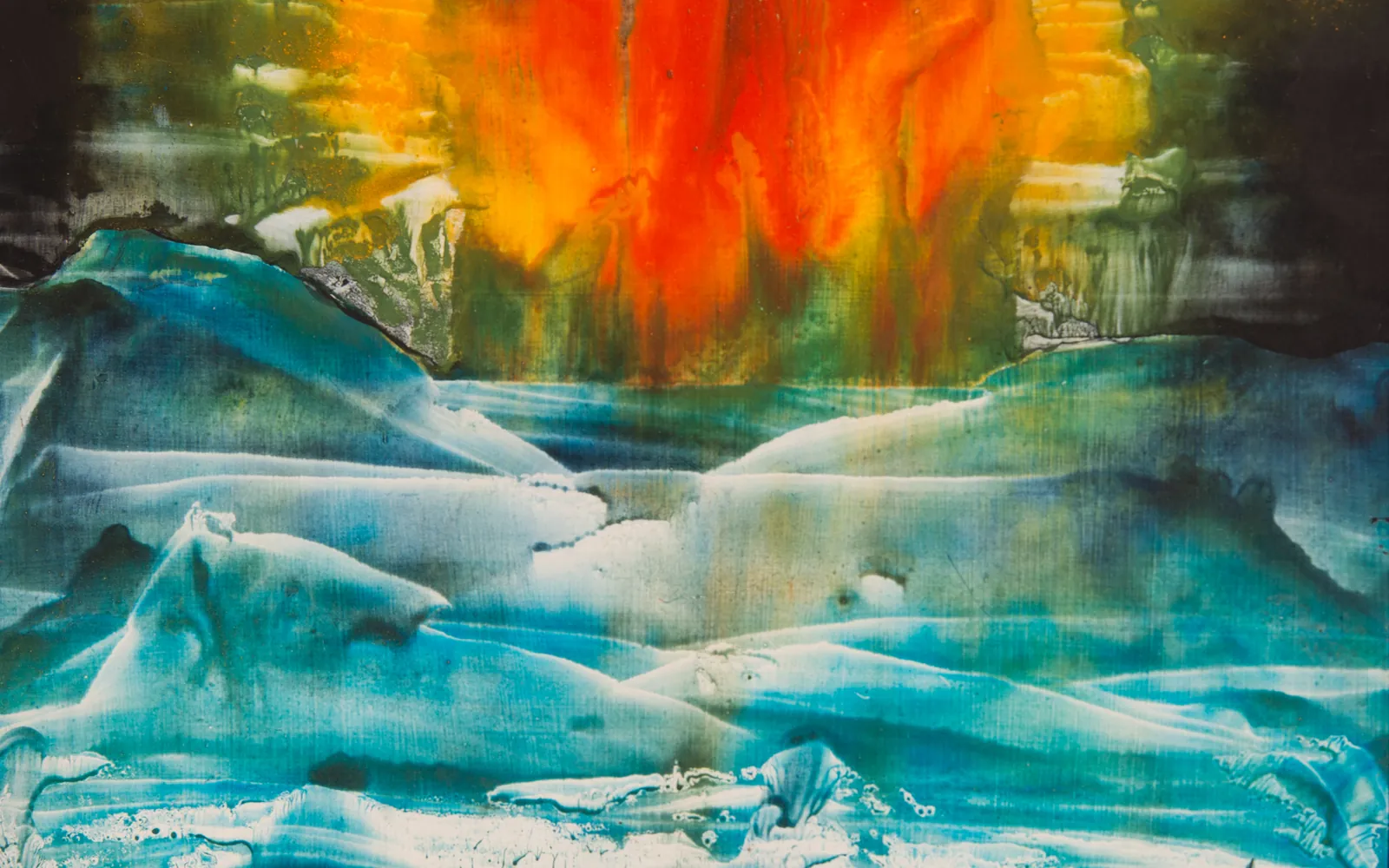
Óscar Domínguez gave the Surrealists one of their most loved tricks. In 1936 he spread gouache on paper, laid another sheet on top, pressed it and peeled it off. The result was a forest of branching, coral-like forms that looked like nothing he could have painted by hand. This page explains how Óscar Domínguez turned decalcomania into a Surrealist method, sketches his life between Tenerife and Paris, and shows how the technique relates to froissage.
From Tenerife to Paris
Wikipedia gives his birth as 3 January 1906 in San Cristóbal de La Laguna on Tenerife, in the Canary Islands. As a young man he spent time in Paris, and in 1933 he met André Breton and Paul Éluard and joined the Surrealist circle. He helped bring Surrealism to his home island: the International Surrealist Exhibition was held in Santa Cruz de Tenerife in 1935, with Breton and Jacqueline Lamba travelling there. (Some sources, including parts of Wikipedia, date this differently, so check a museum chronology if you need the exact year.)
He lived in Paris for most of his adult life, through the German occupation, and remained active in the city’s art world after the war. He died in Paris on 31 December 1957 and is buried in Montparnasse Cemetery.
The 1936 decalcomania
Tate’s art-terms page describes decalcomania as a technique in which paint is squeezed between two surfaces, such as paper or glass, which are then pulled apart. The paint spreads, sticks and tears away in patterns that resemble sponges, mosses, rocks or underwater plants.
Domínguez did not invent the basic principle. Transfer and blot techniques had been used before, and Wikipedia notes a Russian origin for the name. What he did in 1936 was to adopt it as an automatic method, a way of producing images without conscious planning, which was central to Surrealist theory. The Surrealists called it “decalcomania without a preconceived object” because there was no subject in mind at the start.
The technique spread fast. Max Ernst used it on canvas in the late 1930s and 1940s, developing the textures into strange landscapes. Czech Surrealists, including Jindřich Štyrský and Toyen, made their own decalcomanias in Prague; see Czech surrealism and froissage.
Why decalcomania worked so well for the Surrealists
Decalcomania fits the Surrealist interest in images that seem to come from outside the artist. The pressed paint produces forms on many scales at once: large branching masses that break into smaller and smaller veins, like real coral or lichen. The eye cannot help reading them as landscapes, creatures or faces. That is pareidolia at work (see pareidolia in art).
The artist then has a choice: leave the image abstract, or develop it with a brush, as Ernst often did. Froissage offers the same choice with crumpled paper, which is why we describe both as members of one family in surrealist art techniques and chance in art.
Domínguez beyond decalcomania
Decalcomania is only part of his output. His paintings of the 1930s combine dreamlike objects, machines and figures; Wikipedia mentions Retrato de Roma (1933) and The Infernal Machine (1937). After the war he moved through several styles. His work is held by museums in Spain, including on Tenerife, and in other collections. It is still in copyright, so search museum catalogues rather than image sites if you want to see it.
Try a Domínguez-style decalcomania
You need gouache or poster paint, smooth paper or a sheet of glass, a second sheet of paper, and a palette knife or old brush.
- Spread two or three colours thinly and unevenly on the first sheet. Leave some areas bare.
- Lay a second sheet on top and press lightly with your palm. Do not rub.
- Lift one corner and peel slowly. Try peeling fast on another attempt: speed changes the pattern.
- Let both sheets dry; you get two mirror-like images.
- Turn them around until a landscape, creature or cave appears, then add a few details with a fine brush or pen.
Our full decalcomania art technique guide includes troubleshooting and classroom tips. If you enjoy the result, try combining a decalcomania background with a crumpled-paper drawing, as described in froissage collage.
Decalcomania in the classroom
Decalcomania is one of the most reliable chance techniques for groups, because every child gets a striking result in seconds. A few practical points help:
- Use smooth paper. Rough drawing paper soaks up the paint before it can spread. Thin card, glossy magazine pages or a sheet of acetate give crisper branches.
- Limit colours. Two or three colours that mix well (blue and yellow, red and white) avoid brown mud.
- Work in pairs. One child spreads the paint, the other presses and peels. Then they swap.
- Talk before drawing. Ask each pair to find three things in their print before anyone picks up a pen. This is the same looking exercise we use in froissage sessions.
- Keep both halves. The two sheets are mirror images; displayed side by side they make a symmetrical picture that children enjoy.
Our froissage lesson plan can be adapted for a decalcomania session by swapping the crumpling stage for pressing paint.
Domínguez and froissage: what to borrow
For artists who mainly work with crumpled paper, Domínguez offers one useful lesson: do not rush to add drawing. The point of “decalcomania without a preconceived object” was to accept what the paint produced, and many Surrealist decalcomanias were left close to how they came off the paper. Try the same restraint on a froissage sheet: add one tiny element, a boat, a climber, a house, and let the creases do the rest.
Learning more
Tate’s glossary entries on decalcomania and Surrealism are good short introductions. For Domínguez’s biography, start with Wikipedia and then check museum chronologies in Spain and France, since dates for some exhibitions differ between sources.
Decalcomania in Prague
The method crossed Europe quickly. In Prague, Jindřich Štyrský made decalcomanias on paper in the same years; one dated 1936 is shown, photographed in a museum, on our page about Toyen and Štyrský. The Czech Surrealist Group had been founded in 1934, and Breton and Éluard visited Prague in 1935, so ideas passed directly between the two cities. Decalcomania’s success in Prague helps explain why later Czech artists, above all Ladislav Novák, were so receptive to other chance techniques such as froissage.
Related symmetrical techniques
Decalcomania made on a folded sheet produces a mirror image, like an inkblot. Two simple techniques give similar effects and work well with children. In string pull painting, a paint-soaked string is pulled out of a folded sheet, leaving feathery, mirrored shapes. In blow painting with straws, runny paint is pushed with a straw; folding the sheet while the paint is wet adds a mirror half. Comparing all three is a good way to show pupils that the same idea, pressing or pushing liquid paint, can give very different textures.
Frequently asked questions
Did Óscar Domínguez invent decalcomania?
Transfer techniques existed before him, and Wikipedia describes decalcomania as being of Russian origin. Domínguez's contribution, in 1936, was to make it a Surrealist automatic method using gouache pressed between sheets.
What is 'decalcomania without a preconceived object'?
It is the name the Surrealists gave to Domínguez's method: the artist does not plan a subject but presses paint between two surfaces and accepts the textures that result, sometimes developing them afterwards.
How is decalcomania related to froissage?
Both are chance techniques that create an unplanned texture first and invite the artist to find images in it. Decalcomania uses pressed paint; froissage uses the creases of crumpled paper.
Where was Óscar Domínguez born and where did he die?
He was born on 3 January 1906 in San Cristóbal de La Laguna, Tenerife, and died in Paris on 31 December 1957.
Sources
Editorial team
The Froissage.com editorial team researches the history of froissage from museum, encyclopedia and publisher sources and writes practical guides to the technique.