Artists
Brassaï Involuntary Sculptures: Dalí, Minotaure and Paper
Written by Froissage Editorial Team · Updated
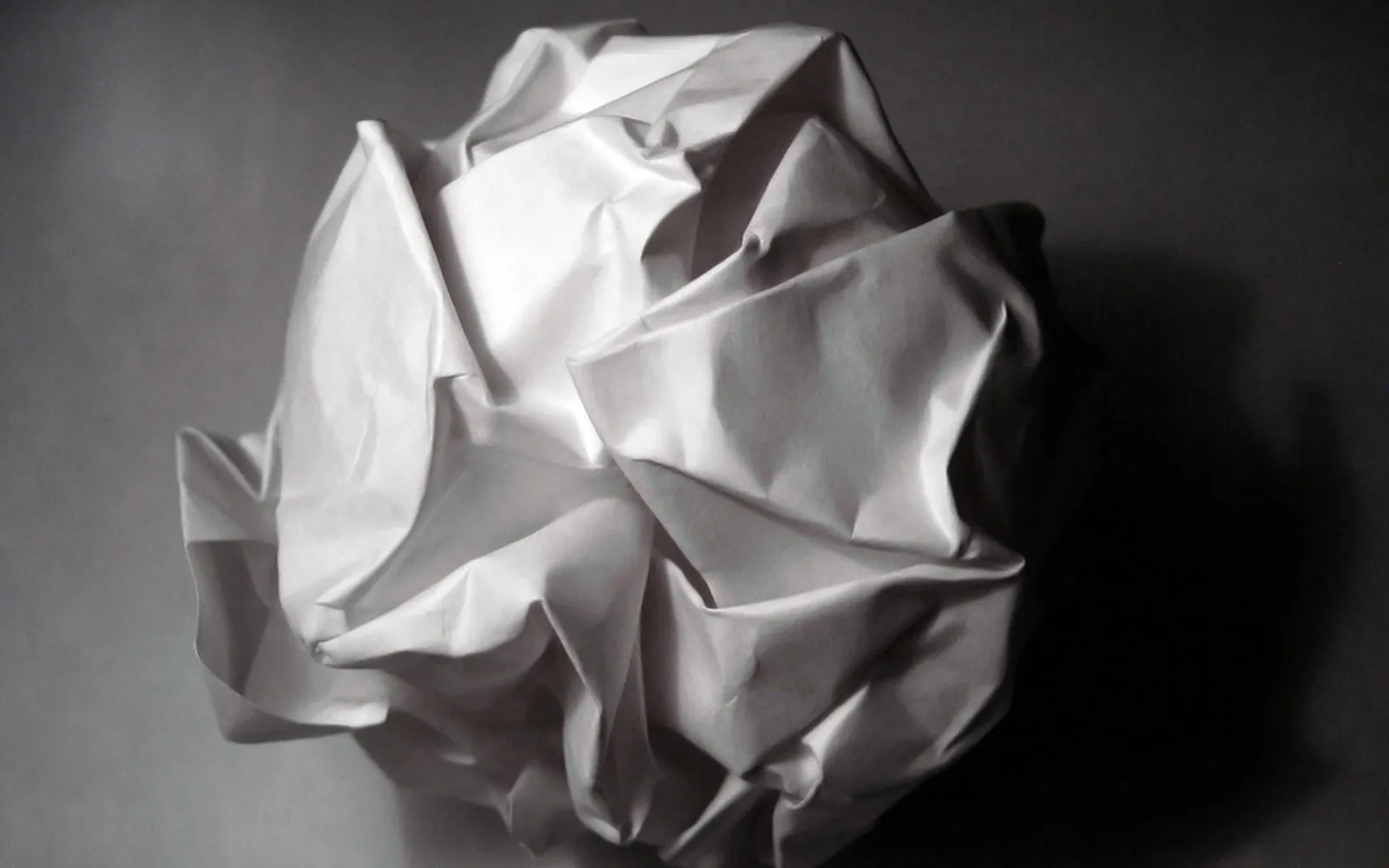
Brassaï’s Involuntary Sculptures are a short series of photographs that turned the most forgettable things imaginable into Surrealist objects: a bus ticket rolled into a tight tube, a sliver of soap curled by use, a scrap of bread pressed between fingers. Photographed in close-up against a plain ground, these crumpled, rolled and twisted bits of matter look like monumental sculpture. A selection appeared in 1933 in the Surrealist magazine Minotaure under the title Sculptures involontaires, with captions by Salvador Dalí.
For anyone interested in froissage, the series is a key reference. It is perhaps the clearest early statement of an idea that runs through this site: that crumpling, folding and fidgeting produce forms nobody designed, and that those forms are worth looking at.
Who was Brassaï?
Brassaï was the working name of Gyula Halász, born on 9 September 1899 in Brassó, Transylvania, then in the Kingdom of Hungary and now Brașov in Romania. His pseudonym means “from Brassó”. He settled in Paris and died on 8 July 1984 at his home in Beaulieu-sur-Mer, on the French Riviera.
He is best known for Paris de nuit (Paris by Night), a book of night photographs of the city published in 1933 by Arts et Métiers Graphiques with a text by Paul Morand. He also photographed many artists and writers among his friends, including Dalí, Picasso, Matisse and Giacometti, and his photographs appeared in Minotaure from its first year.
Minotaure, 1933-1939
Minotaure was a luxurious Paris art magazine published by Albert Skira from 1933 to 1939. It was founded by Skira and the publisher E. Tériade, and its editorial committee included André Breton, Marcel Duchamp, Paul Éluard, Maurice Heine and Pierre Mabille. It ran to 13 issues, released as 11 numbers, because issues 3-4 and 12-13 were doubles. It gave early prominence to many artists, and photographers including Brassaï, Man Ray, Dora Maar, Bill Brandt and Raoul Ubac contributed to it.
The double issue 3-4 of 1933 contains both the Sculptures involontaires page and Dalí’s essay on Art Nouveau (Modern Style) architecture, illustrated with photographs by Man Ray and Brassaï. The Sculptures involontaires page was not signed in the usual way; the magazine’s contents list credits it anonymously.
The photographs
The series consists of small objects photographed so closely that their scale disappears. The objects described in museum and catalogue records include:
- A rolled-up bus ticket, the best known image. Dalí’s caption gives it a long, mock-official title describing it as a bus ticket rolled up and found in the jacket pocket of an average office worker at the Crédit Lyonnais bank.
- A curled sliver of soap, worn into a twisted shape by repeated use.
- A scrap of bread squeezed and shaped by fingers.
- A gob of toothpaste and other small, accidental forms.
The Metropolitan Museum of Art, which holds a print from the series, describes the subjects as objects rolled, folded or shaped unconsciously by idle hands, and dates its print to 1932, the year before publication. The Dalí Foundation’s catalogue raisonné places the project in 1932-1933 and describes Dalí as directing the photographs taken by Brassaï; the original print of the bus ticket is listed in the collection of the Centre Pompidou in Paris.
Because the photographs and Dalí’s texts are still protected by copyright, we do not reproduce them here. The museum and catalogue links in the sources section show them.
Dalí’s captions
Each photograph was published with a caption in Dalí’s deadpan, pseudo-scientific style, treating a fidgeted scrap as a serious specimen. The bus ticket, for example, is described in terms of automatism and stereotype, and the Dalí catalogue links it to the essay on Art Nouveau architecture in the same issue, in which Dalí admired curving, apparently organic forms. The joke is also an argument: the swirling, soft shapes that Dalí praised in Art Nouveau buildings appear spontaneously in a crumpled ticket.
Chance, automatism and the found object
The Involuntary Sculptures belong to the Surrealist interest in automatism, which Tate defines as creating art without conscious thought. Here, the automatic action is not drawing or writing but the small habits of the hands: rolling a ticket while waiting, kneading bread at the table, squeezing a tube. The resulting forms were “made” by a person, but not intended by them.
They are also close relatives of the found object, the everyday item presented as art without (or with little) alteration, an idea associated with Marcel Duchamp’s readymades and taken up widely by the Surrealists. The difference is that the Involuntary Sculptures are not exhibited as objects at all. They exist as photographs, and the camera does the work of transformation: close framing and lighting make a scrap look like a carved monument.
Why it matters for froissage
Froissage starts from the same insight. Crumple a sheet of paper and you create, in a second, a complex landscape of ridges and facets that you could never design by hand. In the froissage technique, that crumpled surface is opened out, washed with ink and developed into a picture. In the Involuntary Sculptures, the crumpled thing is left as it is and shown as sculpture.
Both approaches share three ideas:
- Accident as author. The form comes from an unplanned action, not from the artist’s design. Our page on chance in art follows this idea from Leonardo to the twentieth century.
- Looking as the creative act. The artist’s main contribution is to notice, select and frame. That is the same act of seeing that underlies pareidolia in art.
- Ordinary materials. A ticket, a sheet of paper, a scrap of soap: nothing precious is needed.
Brassaï’s photographs also anticipate a practical point covered on this site: crumpled forms only come alive under the right light. Raking light from one side throws every crease into relief, which is why the advice in crumpled paper texture photography matters as much for documenting froissage as for making new photographs.
The wider Surrealist context
The early 1930s were rich in such experiments. Max Ernst’s frottage (from 1925) lifted textures from floorboards and leaves; Óscar Domínguez’s decalcomania (1936) pressed paint between sheets; Wolfgang Paalen’s fumage used candle smoke. Each found a way to let materials generate form. Our hub on surrealist art techniques brings them together, and the history of froissage shows how crumpled paper itself later became a technique in Czech and French art.
Try it yourself
You can make your own “involuntary sculptures” as a looking and photography exercise:
- Collect small scraps shaped without thinking: a twisted receipt, a folded sweet wrapper, a crumpled sticky note, a rolled ticket.
- Place each one on a plain sheet of card near a window or under a single desk lamp, lit from the side.
- Photograph it as close as your camera or phone will focus, filling the frame so the scale disappears.
- Give each image a caption that describes the object with mock seriousness, in the spirit of Dalí.
With a class, the exercise pairs well with crumpled paper sculpture, where pupils crumple paper on purpose, and with a discussion of the difference between making a form and finding one.
The question of found versus designed form also sits at the heart of a famous architectural legend; see Frank Gehry and crumpled paper.
Frequently asked questions
What are Brassaï's Involuntary Sculptures?
A series of photographs of tiny everyday objects shaped by chance or by idle hands, such as a tightly rolled bus ticket, a curled sliver of soap and a scrap of bread. Brassaï photographed them in close-up so they look like monumental sculptures.
When and where were they published?
A selection appeared under the heading Sculptures involontaires in the Surrealist magazine Minotaure, in the double issue 3-4 of 1933. The photographs were made in 1932-1933.
What was Salvador Dalí's role?
Dalí collaborated on the series and wrote the captions, which describe each object in deadpan, pseudo-scientific language. The Dalí Foundation's catalogue describes him as directing the photographs, which were taken by Brassaï.
Where can I see the photographs?
Museum collections include prints from the series; the Metropolitan Museum of Art in New York and the Centre Pompidou in Paris both list examples. Check their online collection pages, as works are not always on display.
How are the Involuntary Sculptures related to froissage?
Both treat crumpled or folded material as a source of form that nobody designed. Froissage uses the creases of a crumpled sheet as the starting point for a picture; Brassaï and Dalí presented crumpled and rolled scraps as finished sculptures.
Sources
Editorial team
The Froissage.com editorial team researches the history of froissage from museum, encyclopedia and publisher sources and writes practical guides to the technique.