Artists
Toyen and Štyrský: Artificialism, Prague and Decalcomania
Written by Froissage Editorial Team · Updated
Toyen and Štyrský were the central artistic couple of Czech modernism. For twenty years Toyen and Jindřich Štyrský painted, exhibited, edited and theorised side by side, first in Prague, then in Paris, then in Prague again as founders of the Czech Surrealist Group. This page explains who they were, what their movement Artificialism meant, how Štyrský took up decalcomania in the 1930s, and why the pair matters to anyone interested in froissage and the other chance techniques on this site.
Two artists, one partnership
Jindřich Štyrský was born on 11 August 1899 in Dolní Čermná in eastern Bohemia and studied at the Academy of Fine Arts in Prague. Toyen was born Marie Čermínová on 21 September 1902 and studied decorative arts at UMPRUM, the Prague school of applied arts, in 1919-1920. Wikipedia records that the two met in the summer of 1922 and from then on worked closely as a pair.
In 1923 the artist adopted the name Toyen. Wikipedia gives two explanations: a shortening of the French citoyen, “citizen”, or a play on the Czech phrase to je on, “it is he”. Toyen preferred this gender-neutral name and used masculine grammatical forms in speech, which is why many recent writers use “they” for Toyen.
Devětsil and Paris
Both joined Devětsil in 1923. This large Prague avant-garde group included the theorist Karel Teige and the poets Jaroslav Seifert and Vítězslav Nezval, and it kept close ties with French culture. In the mid-1920s Toyen and Štyrský moved to Paris, exhibited there, and in 1928 returned to Prague. Štyrský then worked as a stage designer for the Liberated Theatre (Osvobozené divadlo) in 1928-1929.
What Artificialism meant
In Paris the pair launched a movement of two: Artificialism. In an exhibition leaflet they defined it as “the identification of the painter with the poet”. The idea was a painting that works the way poetry works, through memory, association and atmosphere, without telling a story or copying a scene. Their Artificialist canvases are soft, spattered and textured, close to abstraction but full of hints of objects and places.
Artificialism sat between abstract art and Surrealism. Like the Surrealists, Toyen and Štyrský wanted images that came from the inner life rather than from observation. Unlike them, in the 1920s they did not yet rely on dream imagery or automatic writing. Teige linked Artificialism to his own Poetism, the Devětsil doctrine of art as everyday poetry.
The Czech Surrealist Group
After Nezval and the director Jindřich Honzl met André Breton in Paris, Toyen and Štyrský joined them in March 1934 in founding the Surrealist Group of Czechoslovakia. Breton and Paul Éluard visited Prague in 1935, and Prague became one of the most active Surrealist centres outside Paris. Our page on Czech surrealism and froissage traces that story and the line that runs from it to Ladislav Novák and Jiří Kolář.
Štyrský was also a prolific editor and book designer. He ran the Edition 69 series and the journal Erotická revue, launched in 1930, and edited Odeon. Toyen illustrated hundreds of books; Wikipedia puts the total at over 500.
Štyrský and decalcomania
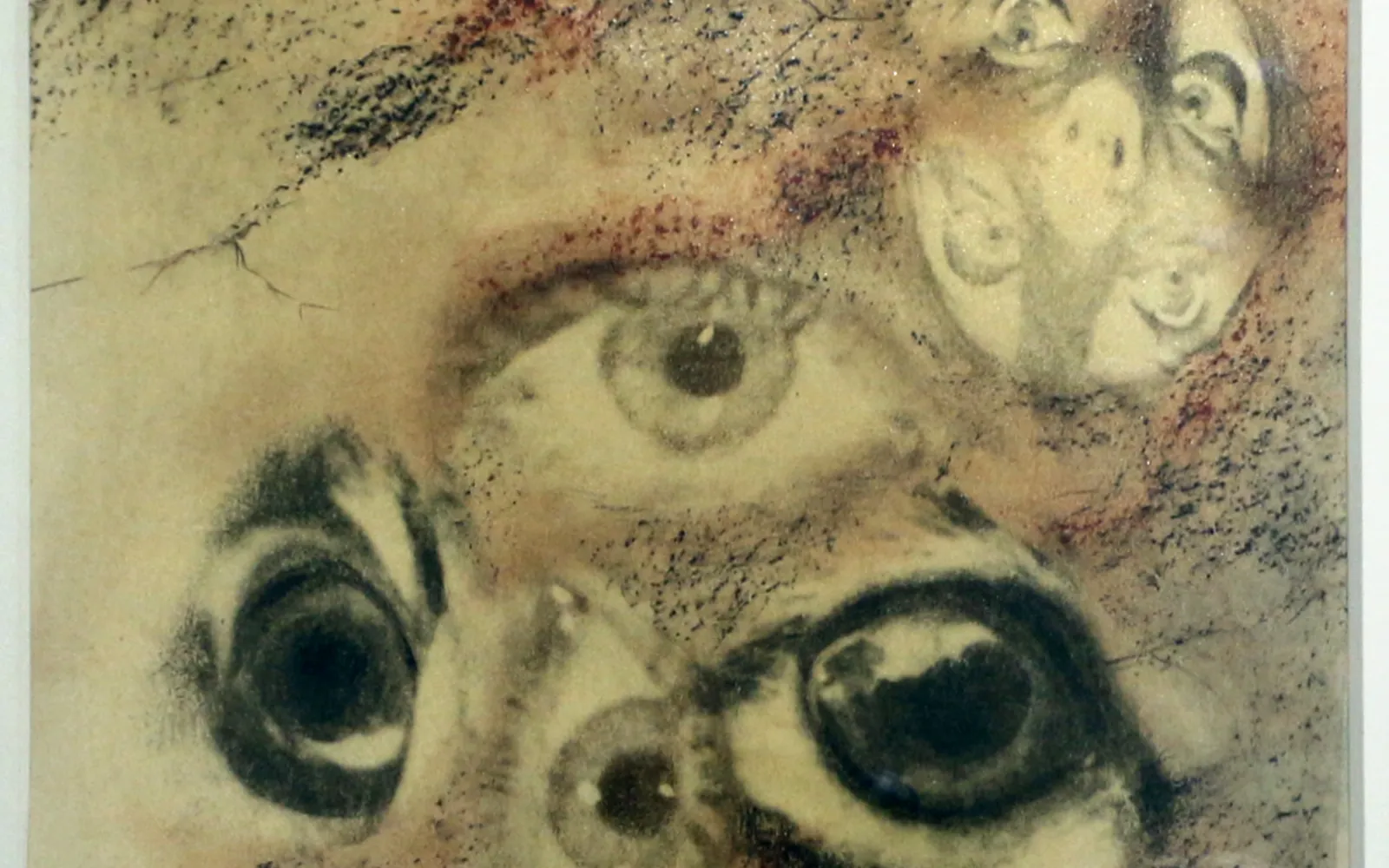
In 1936 Óscar Domínguez made decalcomania a Surrealist method in Paris: paint pressed between two sheets and pulled apart (see Óscar Domínguez and decalcomania). The technique travelled fast, and Štyrský made decalcomanias on paper in the same years. The photograph at the top of this page shows one dated 1936: dark, branching forms that look like eyes, roots or coral, created by pressure rather than by a brush.
These works show how quickly chance techniques moved between Paris and Prague. They also explain why Czech artists of the next generation were so open to methods such as crumpling. For the studio procedure, see our decalcomania art technique guide.
The war years and after
Štyrský fell seriously ill during a stay in Paris in 1935 and recovered only temporarily. In 1941 he made the photographic series On the Needles of the Days with the poet Jindřich Heisler, who wrote the texts. Štyrský died of pneumonia in Prague on 21 March 1942.
During the Nazi occupation Toyen sheltered Heisler, who was of Jewish descent and had joined the Czech Surrealist Group in 1938. In 1947, shortly before the Communist takeover, the two moved permanently to Paris, where Toyen worked with Breton, Benjamin Péret and the Paris Surrealists. Toyen died in Paris on 9 November 1980. An asteroid, (4691) Toyen, is named in their honour.
Why the pair matters for froissage
Froissage became famous in Czechoslovakia through Ladislav Novák in the 1960s (see Ladislav Novák and froissage), and Jiří Kolář built a whole vocabulary of collage techniques in the same period (see Jiří Kolář’s collage techniques). Neither appeared from nowhere. Toyen and Štyrský had already shown, in the 1920s and 1930s, that a Czech artist could make images from texture, accident and association rather than from description. Artificialism’s spattered surfaces and Štyrský’s decalcomanias are part of the soil that Czech chance art grew from.
Seeing their work
The largest public holdings are in Prague. Search the National Gallery Prague online collection for Toyen and Štyrský, and check museum catalogues in France for Toyen’s later Paris work. Toyen’s works are still in copyright, so look at them on museum websites rather than copying images. Štyrský’s are public domain in the European Union, but photographs of them may carry their own licences, as the one on this page does.
Try it: a Prague-style chance study
- Make a small decalcomania with two colours of gouache pressed between smooth sheets.
- Next to it, crumple, open and ink a second sheet in the froissage manner.
- Look at both for a few minutes and write down every image you see, the way the Artificialists treated painting as poetry.
- Develop only one of them with a few pen lines, and leave the other as it is.
The comparison shows what Toyen and Štyrský were after: images that feel found rather than made. For more exercises in the same spirit, see surrealist art techniques.
Frequently asked questions
Who was Toyen?
Toyen was the professional name of Marie Čermínová (21 September 1902 - 9 November 1980), a Czech painter, draughtsman and illustrator and a member of the Surrealist movement. Wikipedia notes that Toyen preferred this gender-neutral name and spoke of themself in the masculine form.
What was Artificialism?
A two-person movement founded by Toyen and Štyrský in Paris in the late 1920s. In an exhibition leaflet they defined it as the identification of the painter with the poet: painting that works like poetry without using words. Karel Teige linked it to his own Poetism.
Did Štyrský make decalcomanias?
Yes. Works by Štyrský in decalcomania on paper dated 1936 survive; one is shown, photographed in a museum, at the top of this page. They belong to the same wave of pressed-paint images that Óscar Domínguez had made a Surrealist method in Paris.
Why does this site not show Toyen's paintings?
Toyen died in 1980, so the works are still protected by copyright in most countries. Štyrský died in 1942, and his works are now in the public domain in the European Union, which is why a photograph of one can be shown.
Sources
Editorial team
The Froissage.com editorial team researches the history of froissage from museum, encyclopedia and publisher sources and writes practical guides to the technique.